Etihad Rail: The UAE’s rail network of the future
- Historic Inaugural Journey
- Stations
- Fines and Penalties
- Etihad Rail Phase 1
- Phase II
- Impact on Business
- Environment Protection
- Passenger Trains
- FAQs
Over the past three decades, the UAE government has launched massive projects to assist commercial entities and boost economic growth. The formation of Etihad Rail, a national railway network that will serve the country’s ever-expanding industries, signalled the start of a massive railway project across the region. Initially, the project focused on freight services by train. However, passenger rail service was also announced to provide a cheaper, faster, greener travel option in the long run.
With the infrastructure 100% complete, cargo train operations launched across all the emirates, and the first passenger train running, it’s the perfect time to look at everything we know about Etihad Rail.
Historic Inaugural Journey
Etihad Rail’s first passenger train completed its historic journey from Fujairah to Abu Dhabi on 30th June 2026, marking a major milestone in the country’s transport system. The train departed from Al Hilal City in Fujairah at 05:34 am on Tuesday and arrived at Mohamed bin Zayed City station in Abu Dhabi at 07:00 am. The train journey between Abu Dhabi and Fujairah takes approximately 1 hour and 45 minutes, offering passengers scenic views through the UAE’s mountainous terrain.
Ticket Prices
For the launch period, Etihad Rail is offering a 50% discount on tickets for the Abu Dhabi–Fujairah route. Discounted fares are:
- AED 55 for Comfort Class
- AED 120 for Premium Class
Etihad Rail’s passenger network is expected to expand quickly, with 10 stations scheduled to open to the public by the end of March 2027.
STATIONS
The authorities have announced 11 stations for the passenger service.
- Abu Dhabi
- Al Sila
- Al Dhannah
- Al Mirfa
- Madinat Zayed
- Mezairaa
- Al Faya
- Mohamed bin Zayed City (Operational)
- Sharjah
- Al Dhaid
- University City
- Fujairah
- Al Hilal (Operational)
- Dubai
- Jumeirah Golf Estates
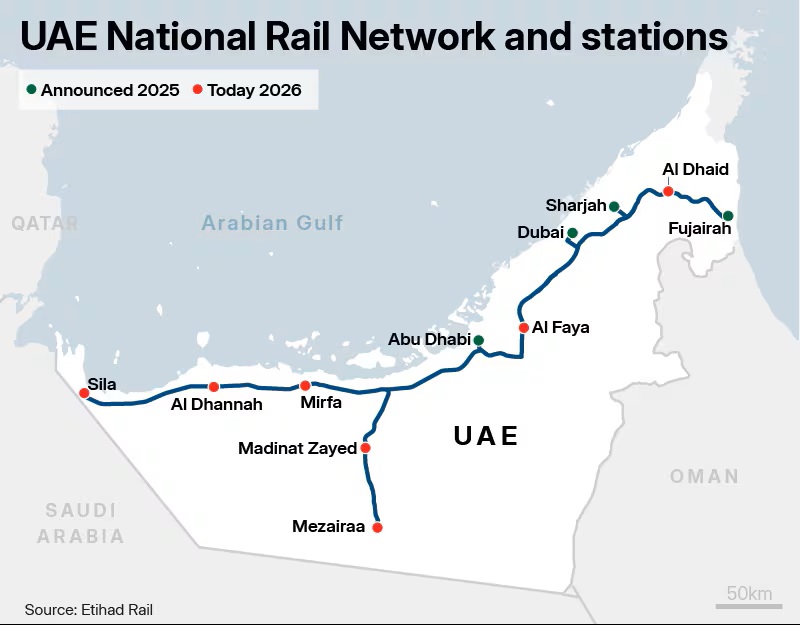
The first operational Etihad Rail passenger stations are:
- Mohamed bin Zayed City – Abu Dhabi
- Fujairah Station
- Jumeirah Golf Estates Station – Dubai will open on 30th September 2026.
- Madinat Zayed and Liwa stations in Abu Dhabi will open on 30th November 2026
The first passenger train between Abu Dhabi and Fujairah was launched on 30th June 2026.
Fines and Penalties
Here’s an overview of the list of violations and their corresponding penalties.
Offence | Fine |
|---|---|
Offence Littering | Fine AED 200 |
Offence Putting feet on train seats | Fine AED 200 |
Offence Refusing to leave the platform when instructed | Fine AED 200 |
Offence Travelling without a valid ticket | Fine AED 200 |
Offence Fare evasion | Fine AED 200 |
Offence Misuse of discounted/concession tickets | Fine AED 200 |
Offence Occupying reserved seats without authorisation | Fine AED 200 |
Offence Carrying prohibited or restricted items | Fine AED 200 |
Offence Travelling in the wrong class | Fine AED 200 |
Offence Failure to comply with Etihad Rail staff instructions | Fine AED 200 |
Offence Travelling while intoxicated | Fine AED 200 |
Offence Possessing or consuming alcohol on board | Fine AED 200 |
Offence Ticket fraud or alteration | Fine AED 200 |
Offence Smoking or vaping in prohibited areas | Fine AED 500 |
Offence Disruptive, abusive or threatening behaviour | Fine AED 500 |
Offence Causing train delays | Fine AED 500 |
Offence Boarding or exiting a moving train | Fine AED 500 |
Offence Possessing or dealing in controlled substances | Fine AED 500 |
Offence Unauthorised commercial photography or filming | Fine AED 500 |
Offence Blocking or interfering with train doors | Fine AED 5,000 |
Offence Tampering with or activating safety equipment without cause | Fine AED 5,000 |
Offence Throwing objects from, at or inside trains | Fine AED 5,000 |
Offence Trespassing on railway land | Fine AED 5,000 |
Offence Damaging trains or station property (including graffiti/vandalism) | Fine AED 5,000 |
Offence False activation of emergency equipment | Fine AED 5,000 |
Offence Misuse of emergency exits | Fine AED 5,000 |
Offence Other unspecified offences (depending on severity) | Fine AED 100 to AED 10,000 |
ALL ABOUT THE ETIHAD RAIL PROJECT – PHASE I
The Etihad Rail project was initiated in 2009. The first phase was completed in 2016, when two trains began operating nationwide. Each train can carry 22,000 tons of sulphur and 110 wagons on a single journey. Interestingly, a single train journey takes over 300 trucks off the road, reducing carbon dioxide emissions by up to 80%.
The UAE imported seven Electro-Motive Diesel locomotives equipped with in-cab European signalling systems from the US for Phase 1 of the rail network. Similarly, all 110 wagons have derailment protection, electronically controlled pneumatic brakes and other extended safety features. Each unloaded wagon weighs 30 tonnes, while the weight increases to 130 tonnes when loaded.
The European Train Control System (ETCS) displays the signalling and movement directly to the cab. The data from the train is sent to Radio Block Centre (RBC), displaying its precise position and directions. The use of odometers, GMS-R or radar and accelerometers are used to refine the train’s position. Speed information and route data are utilised as well.
The two tracks span 264 km and transport granulated sulphur from gas fields in Shah and Habshan to the export point in Ruwais.
PHASE II
With the completion of Phase 2, the Etihad Rail network has connected all seven emirates in the UAE. Plans are underway to link the rail network to the neighbouring five GCC countries. Phase Two of Etihad Rail involved finalising an additional 605 km of track from Ghuweifat, near the Saudi Arabia border, to Fujairah.
The UAE imported another 38 locomotives for stage two of the Etihad Railway project. These machines are designed to pull a 100-wagon train, effectively replacing 5,600 trucks daily.

The Etihad Rail network includes the capital, Abu Dhabi; KIZAD; Port Khalifa; Port Jebel Ali; Sharjah; Ras Al Khaimah; Dubai; and Fujairah on the East Coast. This extension will link the existing line at Ruwais, effectively uniting the trading centres and the major industrial ports within the UAE. The bridge connecting Port Khalifa and the mainland has already been completed. It is one kilometre long, and as many as 320 workers were engaged to complete the project.
Different wagons will be used to transport goods depending on the type of material. These include temperature-controlled carriages, rail gondolas, low-side walls for bulk material, flatbed wagons and intermodal steel containers.
Contracts for Package A were awarded to a joint venture between China State Construction Engineering Corporation and South Korea’s SK Engineering and Construction. This included designing, building, civil engineering and working on the initial 139-kilometre track stretch that connects Ruwais and Ghuweifat.
Package A Stage 2 project has been concluded. The Stage 2 track connects to Al Ghuwaifat on the border of Saudi Arabia with the Stage One project. This covers an area of 264 km from Habshan to Al Ruwais.
Package B and C link Khalifa Port, Khalifa Industrial City (KIZAD), and Jebel Ali Port. This contract was awarded to Ghantoot Transport & General Contracting Company and China Railway Construction Corporation Ltd and included working on the design, building, civil engineering and other rail infrastructure. The routes include Tarif to Saih Shuaib (216 km) and Jebel Ali to Sharjah (94 km).
The fourth package, “D” was also awarded to a joint venture. China Railway Construction Corporation, CRCC, and National Projects and Construction, NPC, worked on the track that runs for 132 km from Sharjah to Fujairah. This route covers Ras Al Khaimah, Sharjah and Fujairah while passing through the Hajar Mountains.
Here is a look at an already completed underbridge structure in Al Bithnah, Fujairah. The multi-span bridge is 600 m long.
Similarly, Etihad Rail has signed contracts with governmental and non-governmental institutions to ensure the project’s swift construction and smooth operations.

His Highness Sheikh Theyab bin Mohammed bin Zayed Al Nahyan, Chairman of the Abu Dhabi Crown Prince’s Court and Etihad Rail, was the chief guest at the laying of the Saih Shuaib railhead track towards Abu Dhabi and Dubai.
In April 2022, the 256 km track linking Abu Dhabi with Dubai was completed. Its construction required 47 million hours and involved over 13,000 workers. The track goes through 60 crossings, 29 bridges and 137 drainage channels.
Interestingly, the final pieces of the track were installed by H.H. Sheikh Theyab bin Mohamed bin Zayed Al Nahyan, Chairman of the Abu Dhabi Crown Prince’s Court and Chairman of Etihad Rail and H.H. Sheikh Maktoum bin Mohammed bin Rashid Al Maktoum, Deputy Ruler of Dubai, Deputy Prime Minister and Minister of Finance.
In June 2022, Etihad Railway commissioned the Spanish Giant CAF to provide and maintain the passenger fleet as per European standards. Each passenger will be able to use incredible new technology during their travel. The cutting-edge technology will mean that these devices will perform reliably and efficiently.
The UAE’s major rail project achieved another milestone in October 2022 as Ras Al Khaimah and Sharjah were connected to the network.
In February 2023, H.H. Sheikh Mohammed bin Rashid launched the freight operations’ main control and maintenance centre nationwide. The network has 38 locomotives and more than 1,000 wagons which can transport all types of goods.
This connects seven logistics centres and four major ports. It includes charging stations in Fujairah Port, Ruwais, Khalifa Port, the Industrial City of Abu Dhabi, Jebel Ali Port, Dubai Industrial City and Al Ghail.
The project is expected to generate AED 200 billion in economic revenue by 2050. Additionally, it is expected that another AED 23 billion in tourism revenue and AED 8 billion in road maintenance will be saved.


On this occasion, H.H. Sheikh Mohammed bin Rashid said stressed that this project will help propel UAE’s economy to greater heights.
“We are proud of the performance of our sons and daughters who have worked hard over the years to build an ambitious strategic project that will propel our national economy to greater heights,” Sheikh Mohammed said.
“Connecting the Emirates via a national railway network strengthens our capabilities and competitiveness, and consolidates our unity,” he added.
THE PASSENGER TRAIN
A fast electric passenger train between Abu Dhabi and Dubai will start operating in 2026, significantly reducing the travel time between the two emirates to only 30 minutes. The trains will travel at a maximum speed of 350kph, passing through important locations and popular tourist spots.
As per the announcements regarding the upcoming Abu Dhabi – Dubai electric rail line, the train will have six stations along its route located at Reem Island, Yas Island, Saadiyat Island, Zayed Airport, near Al Maktoum Airport and in Jaddaf, close to Dubai Creek.
Besides the new 30-minute electrical train route, Etihad Rail will have four passenger stations in Abu Dhabi, Dubai, Sharjah and Fujairah. Etihad Rail’s passenger network primarily aims to connect 11 cities and regions throughout the country. However, there is currently no confirmed date for the launch of the passenger service that will span the entire UAE.
THE FIRST LOOK
The first look of Etihad Rail was unveiled in January 2022. Silver and grey coloured carriages have the Etihad Rail logo displayed prominently. Images were released of what the carriages would look like from the inside, too.
Different types of seating arrangements will be offered according to flight class. You can expect a comfortable journey with considerable spaces between passenger cabins. All carriages will have a Wi-Fi facility, charging points, and entertainment systems, and numerous food and beverage options will be on board. The whole look of the trains can be confidently defined as futuristic, sleek and aerodynamic.
ETIHAD RAIL BRAND IDENTITY
Etihad Rail has unveiled a new brand identity. The design merges an eye of a falcon, a railway track and a train silhouette. The falcon embodies agility and speed, a determination to reach the goal and ability to be be precise with its target. The slogan ‘We Move Together” has also been announced showing a commitment to connecting community.
HOW WILL ETIHAD RAIL IMPACT BUSINESS OPERATIONS IN THE UAE?
The fully operational Etihad Rail network is estimated to replace 5,600 trucks daily. Traffic on road networks will lessen; hence, travelling across the emirates will become faster.
An environmental study conducted before the project launch assessed and predicted its impact. The Etihad Rail project can help reduce pollution as trains emit up to 80% less carbon dioxide than trucks carrying the same load.
The Etihad Railway network can help reduce greenhouse gases by an estimated 2.2 million metric tons annually. It is the same as taking 375,000 vehicles off the road. Similarly, the Emirates Rail network will save the government AED 186 billion in the next four decades.
LUXURY TRAIN SERVICE
In May 2023, Etihad Rail and Arsenale, an Italian luxury hospitality company, signed an agreement to establish a luxury train service project. The “rail cruise” is expected to start at Fujairah and finish at the Liwa desert in the capital. The train will have 15 luxury carriages, which will reflect Emirati heritage.
ENVIRONMENT PROTECTION AND OTHER CONSIDERATIONS
Etihad Rail has conducted Environmental Impact Assessments (EIAs) to reduce environmental effects. This applies to all four project stages: planning, development, construction and operation. Similarly, all contractors have to meet the project standards and guidelines.
During Stage One, 10 road underpasses, two underbridges and 20 overbridges were constructed. Furthermore, 18 small underpasses were built for future use to avoid disrupting traffic flow.
What’s important to note here is that the infrastructure was developed to ensure animal habitats are not impacted in any way. As many as 78 reptile, 10 camel and 22 gazelle underpasses were constructed to monitor the wildlife and protect their habitats closely. Breeding sites have been avoided during the project development, especially for endangered species. Similarly, all vegetation that had to be removed was replanted carefully at a suitable site.
Different fences have also been installed as part of the project, including military fences, boundary, sand mitigation, security and anti-dazzle.
Another key consideration was noise control. There are zero road intersections, so train horns will be only used in emergencies. The tracks don’t have joints, and the ballasts absorb noise and energy. The noise of three locomotives and 110 wagons is expected not to exceed 88 dB at a 25m distance.
FAQS
HOW LONG IS ETIHAD RAIL?
Etihad Rail will cover 1,200 km. Tracks connect to the border of Saudi Arabia to the south and touch Oman to the east. The project’s distribution centres and storehouses will be connected to major transport hubs and storage facilities nationwide. The Etihad rail map posted above outlines the whole project.
WHAT GOODS AND MATERIALS CAN BE TRANSPORTED VIA THE TRAINS?
Etihad Rail can transport everything from food items to raw materials for construction. The plan includes transporting beverages, perishable food, sugar, polymers, metal, shipping containers, waste, hay, ceramics and more.
HOW WILL ETIHAD RAIL HELP BUSINESSES OPERATING IN THE UAE?
The completion of Phase 2 of the Etihad Rail network will make a huge difference for businesses. It will help reduce the country’s carbon footprint and potentially save costs. Indeed, this will transform the logistics industry. Connecting different socio-economic zones will be helpful for businesses trying to expand in other emirates and the neighbouring GCC countries. In the long run, this project will enhance the UAE’s positioning in the global market and make it even more attractive to foreign investors.
WHAT WILL BE THE IMPACT ON THE JOB MARKET OF THIS PROJECT?
Etihad Rail provided an opportunity for Emirati students to specialise in railway education. The first class of such students graduated with diplomas in 2020. It was a proud moment for the country when Maithaa Al Remeithi became the first female Emirati train controller.
A skilled and dedicated workforce will be needed to keep this massive project running, creating new job opportunities. As mentioned, the process of developing a workforce has already commenced.
For the construction, Etihad Rail and First Abu Dhabi Bank (FAB) signed an AED 1.99 billion ($541.8 million) deal financing railway passenger transport services. Such an investment will stimulate the economy in the short term and years to come.
HOW WILL THE ETIHAD RAIL NETWORK BOOST GROWTH AND COLLABORATION IN THE REGION?
Etihad Rail and Oman Rail signed a USD 3 billion cooperation agreement in February 2023 to develop the 303 km UAE-Oman Rail Network to cater to passenger and freight trains. The first phase of the network is expected to start soon and will link Sohar and Abu Dhabi.
The project, known as Hafeet Rail, is a collaborative effort between Etihad Rail, Oman Rail and Mubadala Investment Company. The planned network will link Sohar, through Sohar Port, to Abu Dhabi. The estimated travel time for trains from Abu Dhabi to Sohar is 1 hour and 40 minutes and only 47 minutes from Al Ain to Sohar.
Many innovative transport projects in the UAE are in the pipeline. So you can expect even more comfortable and rapid travel within and between the emirates soon.
Follow MyBayut to learn more about the infrastructure development in the UAE and a lot more.
Featured image credit: Etihad Rail official website